

How To Draw Trend Lines Using Eliot Waves
Past Admiral Markets

Beloved Traders,
Trend lines offer a wide range of analytical trading advantages – equally shown in part one and part 2 of our special series.
Just tendency lines are valuable in other ways besides.
Almost notably:
…they assist identify the starting time of belittling waves within the Elliott Moving ridge (EW) theory…
 Become Our Free Metatrader 4 Indicators - Put Our Free MetaTrader 4 Custom Indicators on your charts when you bring together our Weekly Newsletter
 Get our Weekly Commitment of Traders Reports - See where the biggest traders (Hedge Funds and Commercial Hedgers) are positioned in the futures markets on a weekly ground.
…and they recognize where the waves are expected to finish.
By the end of this article, you will know how to correctly combine trend lines and waves.
So let's get started.
The first step is to show you how to build a trend channel based on EW, so:
- explicate the value of such a aqueduct
- clarify how the same technique can be used in different conditions.
Sound hard?
Don't worry – our explanation is beginner friendly.
You lot can read more about it offline too, with our gratuitous ebook.
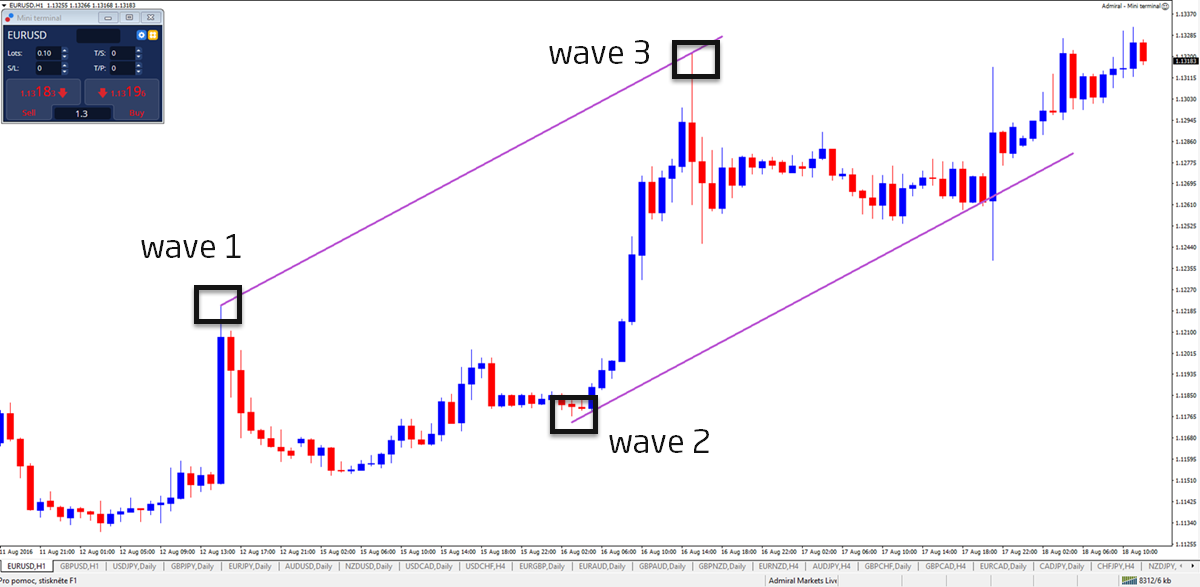
Connecting waves 1 and 3
First of all, let's start with two primal rules for trend lines and waves.
Namely:
- lines always require ii points on the chart, earlier you can draw a tendency line with EW
- waves one and three are parts (or swings) of the chart, that show strong bearish or bullish momentum.
Keep this in my mind when you browse the charts.
Once you lot find a stronger 3rd swing than the previous one:
- move in the same management
- connect waves 1 and 3 with a trend line, which provides the angle of the trend
- draw a new EW trend line, which is exactly parallel to the first line (in pace 1)
- hook the 2nd trend line to the bottom of wave 2, which is the indicate connecting waves i and iii (in case of an uptrend i.e. to the superlative in a downtrend).
Hopefully you now have a trend channel visible on your chart and take successfully used tendency lines with EW pattern.
If you lot don't – follow the steps again.
Continue in mind that the steps might seem complicated at outset:
…but risk-gratis practise volition make it much easier.
The importance of aqueduct
The channel offers a concrete method for finding back up or resistance.
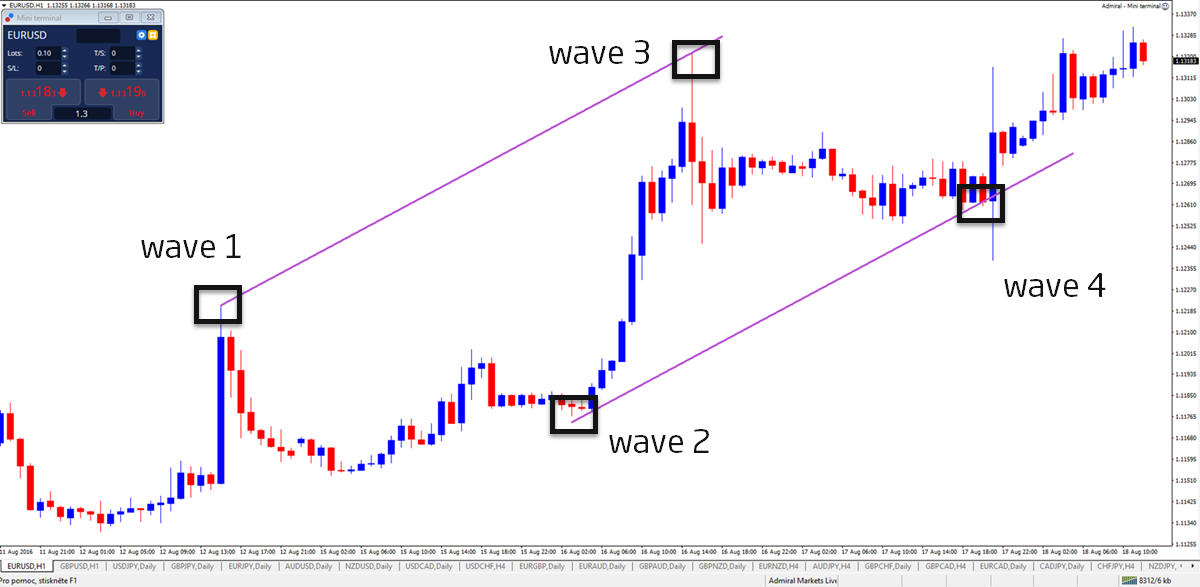
Specifically, it shows traders how to find wave 4.
In wave iv:
- a bullish channel indicates that price is expected to receive support at the bottom of the channel, which is the parallel trend line connected to the support indicate of wave two
- a bearish channel indicates that price is expected to receive resistance at the top of the channel, which is the parallel trend line connected to the resistance bespeak of moving ridge two
- the turning spot at the channel, is literally called wave 4.
As you tin can see below:
- waves 2 and four are corrective movements (slow)
- waves 1 and 3 are impulsive pieces of toll action (quick).
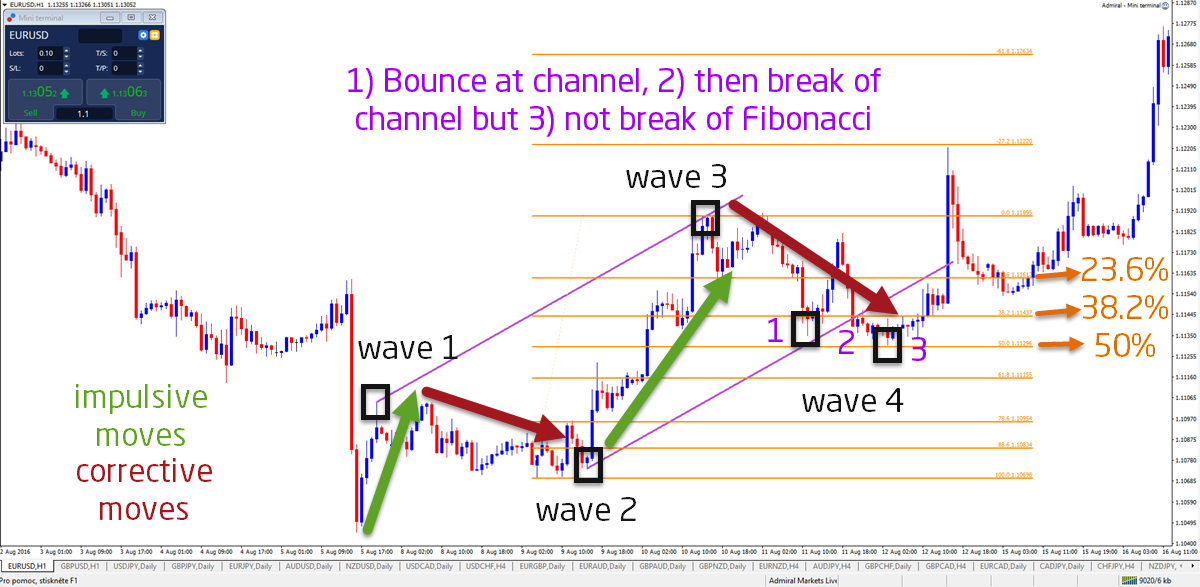
This technique often works well, but it occasionally has a weakness too.
When?
Virtually notably:
…if moving ridge 4 turns out to be lengthy consolidation zones.
To counter that problem, y'all:
- add a Fibonacci retracement tool from the finish point of wave two, to the end point of moving ridge 3)
- go on an centre on the 23.6%, 38.2% or 50% Fibonacci retracement levels – which are where toll should terminate if it'south in a wave 4
- notation that if price does break the 50% Fibonacci level, then it is most likely non a moving ridge 4.
Next forecasts with wave channels
Then now we've covered waves one to four, permit'due south expect at moving ridge v.
Wave five marks the end of the trend and the channel.
The good news is:
…you can utilise more or less the same channel that helped connect waves 1 to 4.
Here'due south how.
Firstly, connect waves 2 and 4 then:
- claw the second tendency line, to the height of moving ridge 3 in an uptrend and the bottom in a downtrend
- await wave 5 to terminate at the top of the channel in an uptrend and the bottom in a downtrend.
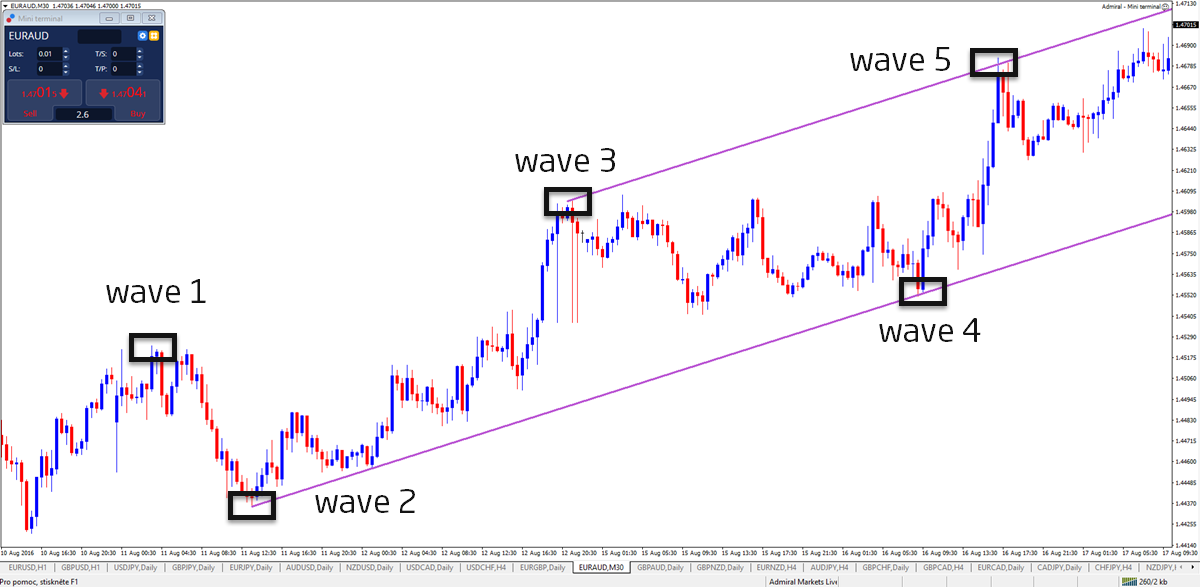
Wave 5 does have one specific danger though:
…it tends to lose momentum because the trend is almost completed.
But thankfully there is an effective countermeasure.
To avoid this danger, simply:
- draw a third EW trend line that is parallel to the beginning ii tendency lines, and
- place information technology in the centre of the aqueduct (the pink line in the image below).
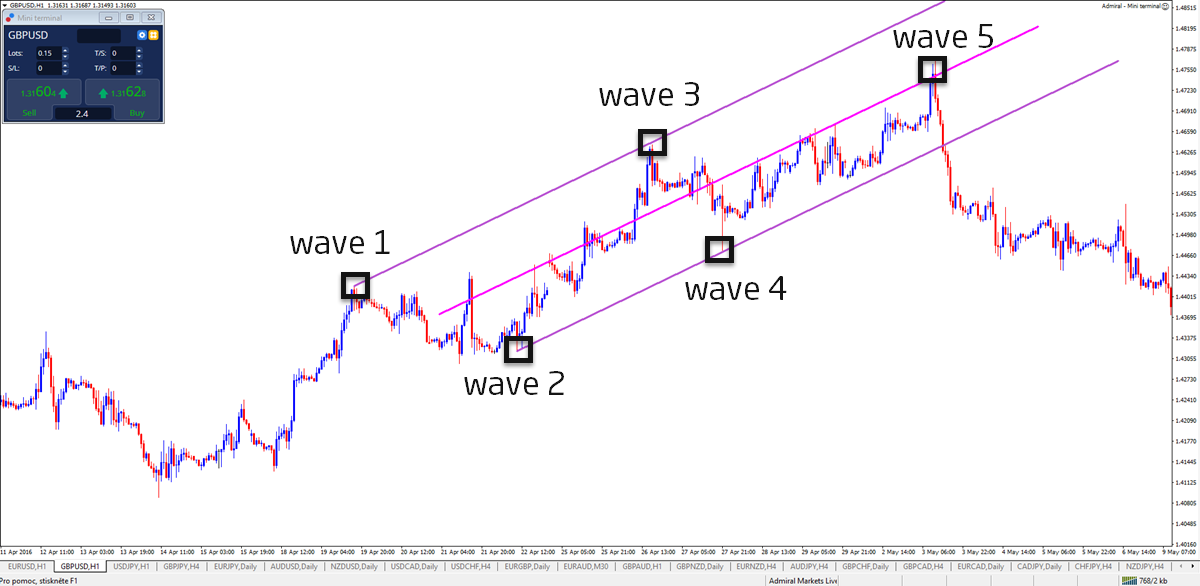
The 3rd middle trend line offers a safer target spot for the completion of wave v, than the official target at the top (bull) or bottom (acquit) of the aqueduct.
Cosmetic trend line predictions
Toll somewhen makes a correction, even within trends.
The swell matter is that traders can also utilize trend lines, for estimating price corrections.
Remember, trend lines are peculiarly formidable tools for establishing the start and finish of corrections.
At present, to empathize trend line predictions – you need to know that corrections take identify every bit:
- fast paced price movements called zigzags corrections, or
- slower cost movements called sideways corrections.
During a zigzag correction, traders can exercise the same steps as mentioned for determining other waves – but modify by connecting different highs and lows.
For case:
- connect the trend line between a:
- superlative and lower high, during bearish reversal of the uptrend
- bottom and higher lower for bullish reversal of the downtrend
- draw a second trend line, which is exactly parallel to the first line
- hook the 2d trend line to the:
- bottom in bearish reversal
- meridian in bullish reversal
- notation the main target (see green checks in below image), is the
- support trend line in surly reversal
- resistance trend line in bullish reversal ( see the dark-green cheque in image).
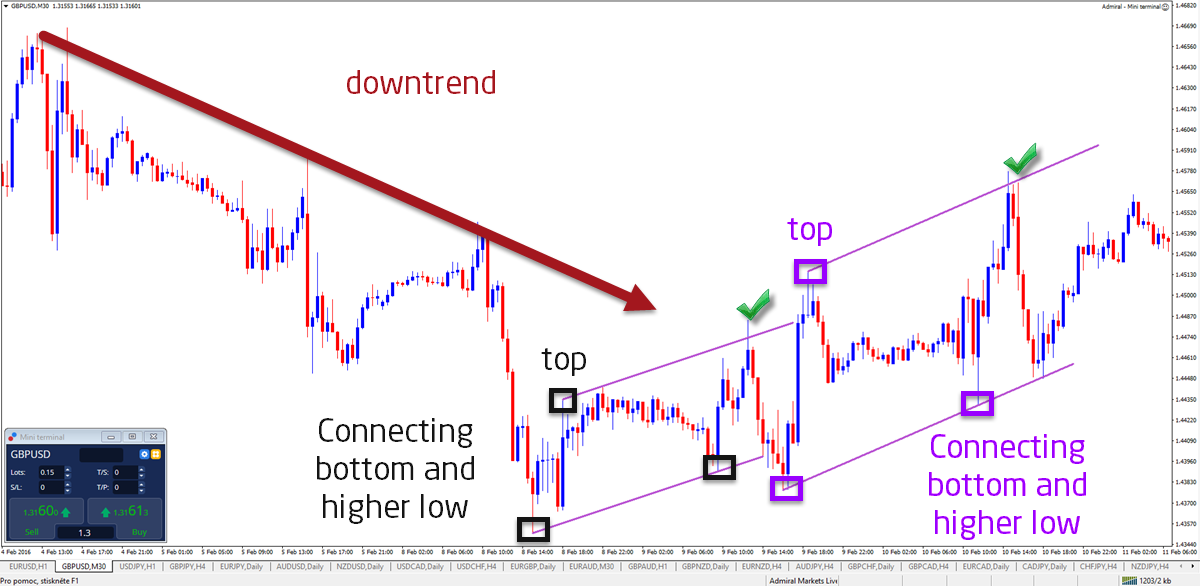
During a sideways correction, traders can connect various tops and bottoms – to determine a wide range of EW nautical chart patterns.
Please view our dedicated webinar, for a total overview of all the bachelor patterns.
If you lot have already used trend lines and waves – I would love to hear about your experience in the comments below.
Cheers and safe trading,
Chris
Commodity by Admiral Markets
Source: How to describe trend lines with Elliott Wave

Admiral Markets is a leading online provider, offering trading with Forex and CFDs on stocks, indices, precious metals and energy.
Run into More than Elliott Wave:
 The Elliott Wave Principle
– The first stride in Elliott moving ridge assay is to identify patterns in market prices.
Elliott Waves Point to Market place Probabilities
– Each moving ridge in price reflects the dominant investor mood. For example, stiff price advances on high volume typically happen during wave 3, the healthiest leg of a balderdash market. The contrary happens during 3rd waves in bear markets — conspicuous fear drives prices lower.

Source: https://www.investmacro.com/forex/2016/09/how-to-draw-trend-lines-with-elliott-wave/
Posted by: brownhatichoode.blogspot.com
0 Response to "How To Draw Trend Lines Using Eliot Waves"
Post a Comment